Sunday, March 15, 2015

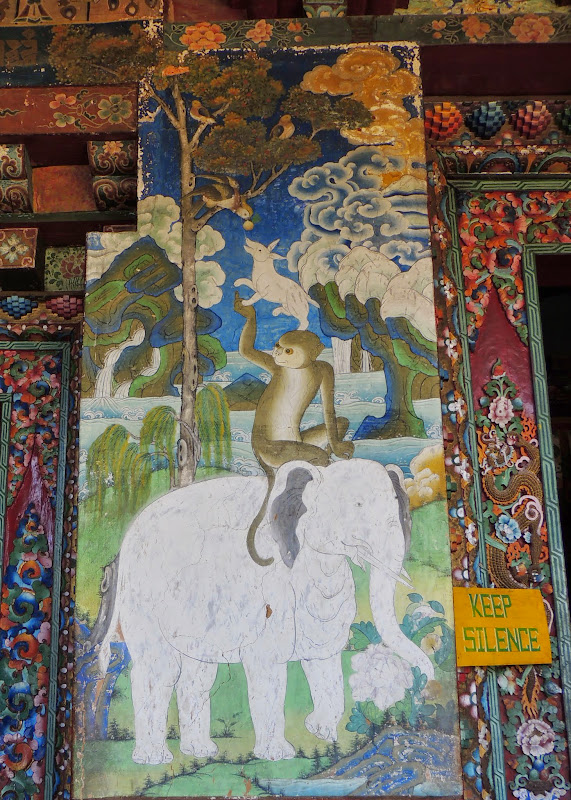
The Four Friends

Depiction of the Four Friends on the entrance of the Pemayangtse Monastery near Pelling in Sikkim.
More about the monastery at http://anushankarn.blogspot.in/2015/03/pemayangtse-monastery-of-art-faith-and.html


Long long ago, there lived four animals in a forest – an elephant, a monkey, a rabbit and a pheasant. There arose a question, as to who was to be venerated, and they all agreed that the oldest deserved the most respect. But who among them was the oldest?


Monday, September 19, 2011

Varaha - The Wild Boar


Hiranyaksha and Hiranyakashipu were both sons of the sage Kashyapa, born of his second wife, Diti. Strong and valiant from childhood, they grew to be extremely powerful, and as their power grew, so did their ego. Hiranyaksha’s thirst for invincibility led him to perform great penances to Brahma in search for immortality. However, even the creator couldn’t bless a mortal with immortality, so Hiranyaksha settled instead for immunity from all creatures – human, divine and animal. To make doubly sure that he would indeed be safe from all creatures, he enumerated each creature he thought of! Brahma had no choice but to agree, bound as he was by the power of the sacrifices and penances Hiranyaksha had performed.

Friday, September 9, 2011

Ganesha and Kaveri


Kaveri is one of the major rivers in India and figures among the seven holiest of rivers. In south India, she is considered to be even holier than the Ganga! She originates in the heart of the Western Ghats, amidst the picturesque surroundings of Coorg, at Talakaveri, from where she flows down through the plains of Karnataka and Tamilnadu, before finally merging into the Bay of Bengal at Poompuhar. As with all rivers in India, she is considered to be a goddess and her origin at Talakaveri has an interesting story behind it, in which Ganesha plays a small, but pivotal role!

The Story of Kaveri as shown in a temple painting
(Image from http://ganeshway.blogspot.com)


The king Kavera ruled over South India. Though he and his wife were kind and well loved rulers, they were sad because they were childless. They prayed to Brahma, who blessed them with a divine baby girl, who came to be known as Kaveri – the daughter of Kavera. When Kaveri was of marriageable age, she refused to marry any of the kings who presented their suit. She wanted to be the wife of someone exceptional, someone who could compare with even Brahma, the creator, who had given her in blessing to the king. She went off to the Sahya mountains (the Sahayadris in the Western Ghats) to meditate on the creator to get her wish fulfilled.

Thursday, September 8, 2011

How Ganesha Broke His Tusk


Ganesha is usually depicted with one of his tusks broken. Have you wondered when and how the elephant headed god managed to break just one tusk? Was it an indication of ivory being used even then? Or did he get it broken in a fight? As with most other features of Ganesha, there are two stories to explain this too!

Sage Vyasa dictating the Mahabharata to Ganesha
(Image from the internet)


The first and the more popular story is related to the sage Vyasa and the Mahabharata.

Wednesday, September 7, 2011

Why Ganesha Loves Dhurva Grass


The first and main offering for Lord Ganesha is the Dhurva grass. The grass grows wild all over India, and is rarely used for anything else. Why then is it so important for Ganesha? Read this story to find out!

 
A depiction of the story of Dhurva at a pandal last year

There once lived a demon named Analasura, whose evil acts had the Gods worried.

Tuesday, September 6, 2011

Novel Methods of Obeisance


In South India, devotees have two novel methods of worshipping Lord Ganesha. The first one is where they tap their temples (side of the head behind the eyes) with their knuckles (making a fist). The second is where they cross their arms and pull their ear lobes, while performing sit ups! Do you know how these interesting methods of obeisance came about?

Monday, September 5, 2011

Ravana and Ganesha


Ravana trying to pull the linga out
as Ganesha in the form of a child  looks on
(Image courtesy; Rajan Draws)


Ravana was the demon king of Lanka. The son of sage Vishravas and the demon princess Kaikesi, he performed great penances to become the master of the three worlds. While he gained his kingdom and strength by meditating on the creator, Lord Brahma, he later went on to become one of the greatest devotees of Lord Shiva. Read the story WhenRavana Lifted Kailash to know more about how that came about.

Ravana’s mother used to pray to Lord Shiva everyday by making a Shiva lingam with sand. Day after day, the sea would swallow up the sand lingam, and she would make a new one the next day. Once, she mentioned to Ravana that she wished she had a special lingam that she could pray to every day, without having to make another one every single day.

Sunday, September 4, 2011

The Race for the Mango


Ganesha and Karthikeya were both sons of Shiva and Parvati. The two brothers, like all siblings, fought and loved with equal enthusiasm. While each one always stood by the other in times of trouble, they competed with each other with the same fervor. This is the story of one such confrontation – in fact, one of their most popular confrontations.

Ganesha and Karthikeya
(Image from the internet)


The sage Narada was known for kindling trouble. He always turned up when things were calm and peaceful, and by the time he left, he would have succeeded in churning up a storm! He arrived one fine day at Mount Kailas, bearing in his hand, a ripe, juicy mango. Now, mangoes are considered to be divine among fruits, for it is not an easy matter to grow a perfect mango, and they are thus fruits in great demand, but always in short supply.

Saturday, September 3, 2011

Phases of the Moon


Mythology has stories for everything. Every scientific fact or event has an explanation, and sometimes, even multiple explanations…. One such story relates to the phases of the moon.

The first story concerns Ganesha….

Bhalachandra - Ganesha with the moon on his forehead
(Image from the internet)


Once, Ganesha, after an exceptionally heavy dinner, decided to go on a round. He mounted his vehicle, the mouse, and set off. Suddenly, a snake came in their path, and the mouse panicked. Ganesha fell off, and his stomach ruptured! Nonplussed, Ganesha simply picked up the snake and tied it around his waist like a belt!
This scene was witnessed by the moon, Chandra, who found it extremely funny and laughed aloud! Ganesha, who, till then hadn’t been bothered, was extremely angry that the moon had laughed at him. He cursed Chandra that he would lose his luster at once! Chandra realized his folly and apologized, and as the moon continued to wane, putting earth in jeopardy, Ganesha relented.

Friday, September 2, 2011

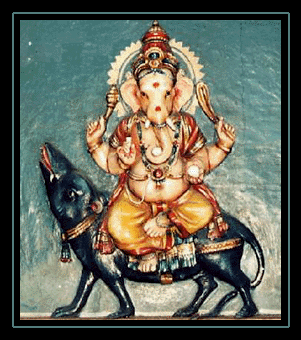
Ganesha gets a vehicle


We know that Ganesha's vehicle is a mouse. The sight of the huge potbellied God on a tiny mouse is an incongruous sight, and many of us would have wondered how the tiny mouse bears the weight of the God! Let me tell you how Ganesha got such a vehicle.

Mooshika Vahana
The one who has the mouse as his vehicle
(image from the internet)


There was once a Gandharva (a celestial being) named Kroncha. Now, Gandharvas are believed to be extremely good looking and talented. This frequently makes them quite vain and proud. This was the case with Kroncha too. In the court of Indra, he once met the sage Vamadeva, and filled with pride, insulted him. This incited the anger of the sage, who cursed him that he would lose the good looks he was so proud of, and become a mouse!

Ganesha and Kubera


Ganesha and Kubera
Image courtesy: Rajan Draws

One of Ganesha’s names is Lambodara – the huge bellied one! Have you wondered how he got his potbelly? The story goes back to the first encounter of Ganesha and Kubera, the treasurer of the Gods.

Kubera, being the God of wealth, was a complete contrast to Lord Shiva. While Shiva covered himself in ashes, Kubera draped himself in yards of the finest silk; while Shiva wore snakes as ornaments, Kubera was decked in glittering gold; while Shiva lived in seclusion among the monks and hermits, Kubera lived in the lap of luxury in a huge palace filled with every possible comfort. Most importantly, while Shiva was the epitome of detachment, Kubera was vain and proud. His pride led him to believe that he was greater than the Gods. He was especially disdainful of Shiva, whom he considered uncouth and destitute.

Thursday, September 1, 2011

Birth of Ganesha


Raja Ravi Varma's rendition of the divine family
Image from the net

The story of Ganesha's birth begins with the story of Shiva and Parvati. Shiva is god of destruction. He maintains the balance of life on earth, and is a mendicant, happiest when living alone, away from society. Embodying the spirit of selflessness and detachment, he is usually shown covered in ashes, his hair matted, and wearing snakes as ornaments. His name “Shiva” or “Siva” means “pure”. He does not need the accruements of dress or jewelry to state his position. He is above all that. His consort, Parvati, on the other hand, is a daughter of the king of the mountains. She, who grows up amidst every luxury and comfort possible, gives up everything to be with her lord. It is these differences between the divine couple that led to the creation of Ganesha. Here then, is the legend which talks of the birth of Ganesha.

Wednesday, August 31, 2011

Ganesh Chaturthi

Ganesha or Ganpati is one of the most loved among Indian gods. Not only is he the son of Shiva and Parvati, but his elephant head and potbelly make him appear cute and approachable, unlike our other gods in their warrior stances. (The only other God who competes with Ganesha for popularity is Krishna, who is loved for his adorably mischievous smile and good looks!). Also, unlike many of our gods, he is believed to prefer using his brains rather than brawn, to solve problems – another trait which makes him lovable.

As we get ready to celebrate Ganesh Chaturthi, I have decided to write a series of posts about the festival itself and the different stories related to Ganesha. On this auspicious day, I begin with the story of the festival, and how it is celebrated.


Friday, March 18, 2011

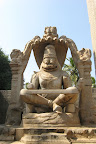
Narasimha


Lakshmi Narasimha monolothic statue at Hampi
Good and evil are two sides of the same coin – they are brothers, who look opposite ways.  Such were the Devas and Asuras too. Kashyapa was a great sage – he was one among the Saptarishis (the seven greatest rishis or sages of all time).  He had two wives – Aditi and Diti, both daughters of Daksha Prajapati. Through Aditi, he begot the Devas – the Gods, and through Diti, he was father of the Asuras – the demons.  This is the story of one of his sons – Hiranyakashipu.

Thursday, March 10, 2011

Ardhanareeshwara


Ardhanareeshwara – literally meaning the Lord whose one half is a woman – represents Lord Shiva and Parvati as one. This form symbolizes the equality of men and women, and is a beautiful rendering in sculpture with each half showing a detailed rendition of the male and female halves of divinity.

Ardhanareeshwara with sage Bhringi on left and Parvat's attendant on right.
Location: Badami


There is an interesting story behind this manifestation –

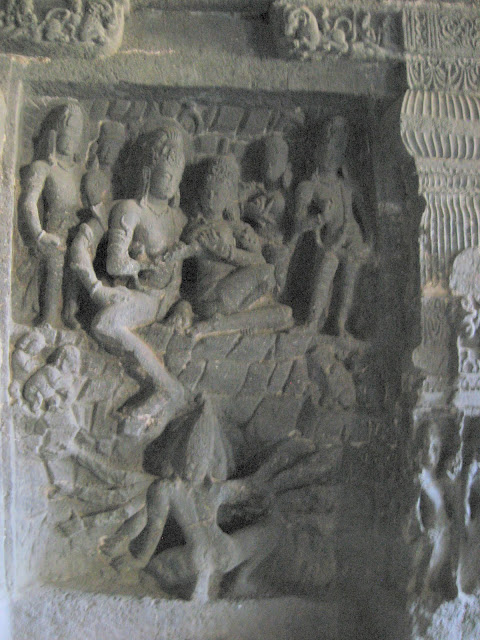
When Ravana lifted Kailash....


We have all heard that Ravana was one of the greatest devotees of Lord Shiva. But not many know how he became a devotee of the Lord. This is the story of Ravana lifting mount Kailash, which is a prelude to his devotion.

Ravana had always been jealous of his half – brother, Kubera, who was the treasurer of the Gods. Right from childhood, he wanted to prove himself stronger, and more powerful than Kubera, and accordingly performed penance to gain strength and power. As soon as his penance yielded results, he attacked Kubera and looted his magnificent city, taking whatever he wished to.

Ravana was returning from Kubera’s city, when suddenly, his aerial vehicle stopped. He was surprised, and enquired about the reason. When he learnt that this was the abode of Lord Shiva, and that no one was allowed to pass that way, he was livid! Arrogant, and believing himself to be all-powerful, he refused to change his path, and decided to challenge the Lord himself! Getting down from his vehicle, he went to the foot of the mountain and began uprooting it with his immense strength!

Meanwhile, Lord Shiva, Parvati and the others on the mountain were disturbed by the shaking of the mountain. While Parvati and the other women worried about the cause of the disturbance, Shiva simply smiled. When at last, Ravana had managed to lift the entire mountain, Lord Shiva simply pressed his toe down….. and the huge mountain came back down to earth, crushing Ravana underneath!

At last, Ravana realized his error, and from under the mountain, prayed to Lord Shiva, who blessed and released him. It is also believed that when he was crushed under the mountain, he sang out to the Lord for mercy, and his composition so pleased the Lord that he forgave him at once! It is believed that these words were the origin of the ‘Sama Gaanam’ – the ritual singing of the hymns of the Sama Veda! This is the origin of one of the names of Lord Shiva  - ‘Saama Gaana Priya’-  one who loves the music of the Sama Veda.

And that was how Ravana became one of the greatest devotees of Lord Shiva!

Saturday, July 3, 2010

When the Lord became a Weaver....


Once upon a time, there lived two young men in a village. One was a weaver and the other a carpenter. They were very good friends, and were extremely attached to each other.

One day, they attended the annual village festival, which was a grand affair. People had come from far flung places to pay their respects to the deity.

One of the visitors was the young princess of their kingdom. All eyes were on her as she alighted from the elephant. Her long dark hair flew in the wind, while her lotus-shaped eyes took in all the happenings around her. Everyone seemed to be enraptured by her beauty, but the weaver fell in love with her the moment he set eyes on her. He could not take his eyes off her all day long, it was only when she left, that he turned to go back home.

The weaver was unable to get the princess out of his heart, and spent the night lost in her thought.  Even the rising sun did not succeed in weaning him away from his dreams, and his friend was surprised by his behavior. “My friend, what is it that ails you?” asked the carpenter, in concern.

“My friend, I have fallen in love! This is the source of my unhappiness, for I know that I can never gain her hand!” replied the weaver, sadly. The carpenter continued to question his friend till at last, he learnt the whole story. He could not bear to see his friend grieve in this manner, and so he decided to help him.

“My dear friend,” he said, “Do not give up so easily. I assure you that I shall help you marry the princess.” The weaver was thrilled hearing his friend’s words, but he was also doubtful of success. “She lives in a palace surrounded by guards, and is the daughter of the king! How can I, a mere weaver, get to meet her, let alone marry her?”

The carpenter replied, “We may be ordinary men, but we are devout, and intelligent. If we use our intelligence, the Lord will surely help us achieve our goals. So, do not worry, but get ready and weave wonderful clothes for yourself so that you can meet the princess!”

Heartened by his friend’s assurance, the weaver got to work, and wove the most beautiful and expensive clothes he had ever made, his mind and heart fixed on the woman of his dreams.

Meanwhile, the carpenter was busy at work too. He returned the next day, bringing with him a mechanical contraption, which looked like the Garuda, the vehicle of Lord Vishnu. The bird was fitted with different levers, which enabled it to fly.

He taught his friend how to use the bird, and said, “Friend, using this bird, you can easily fly high over the houses in our kingdom and reach the palace. No one can obstruct you, and you can easily reach the palace, without bothering about the guards who maintain a watch over the princess. Go late at night, so that no one will observe you, but just in case someone does catch a glimpse, he will think you are the lord Vishnu, and thus you shall be safe. Just in case, dress yourself as Lord Vishnu, which will aid you in concealing your identity, as well as winning the hand of the princess.”

The weaver was so happy with the plan that he hugged his friend and thanked him, and began preparations for his night-time jaunt. He wore the wonderful clothes he had made for himself, and adorned himself with jewelry fit for a God, and prepared to meet his love. Bowing before the lord, and asking for His blessings, he set off towards the palace.

Easily avoiding the palace guards, the weaver made his way on his mechanical Garuda to the princess’ apartments.  The princess was stunned to see the Lord in front of her, but even more surprised when he said, “O Princess, I have fallen  in love with you and have arrived here to marry you. Please consent to be my wife!”

The princess replied, with all due modesty, “O lord, I am honored by your words, but I am just a mortal girl. How can I marry you? Besides, the goddess Lakshmi is your rightful consort. How can you approach me thus?”

The weaver was well prepared for just such a question, and replied with a smile, “My dear, it is you who are my wife, born in this form due to a curse. I have sheltered you from other suitors for so long, but now it is time for me to make you my wife.”

The princess blushed and replied, “In that case, my lord, please talk to my father and take his permission. I shall marry you at once with his blessings.”

The weaver interrupted her, “My dear, it is not easy for mortals to set eyes on me. They have to perform severe penances for just a glimpse of me. I cannot grant your father this boon without due cause.  Marry me at once in the Gandharva style, or I shall curse your family!”

The princes did not want to be the cause of her family’s doom, and she was also thrilled by her good fortune in being the wife of Lord Vishnu. Agreeing to the terms laid down by the weaver, she married him in the Gandharva style at once. The weaver spent the night happily with his wife and left at dawn. Thereafter, he visited the princess every night and left before sunrise.

Meanwhile, the princess’ attendants suspected that the princess was meeting a man. However, since they did not see any man near the palace, they were confused. At last, one of them went to the king and voiced his suspicions.

The king was very angry when he learnt of the intruder, and he and his wife questioned the princess in detail. Unable to lie to her parents, she blurted out the truth – “My dear parents, you have no cause to worry, but instead, you should rejoice, for it is no common man who has chosen your daughter as his life partner. It is the Lord Vishnu himself, who comes to me every night. If you do not believe me, you can hide in my apartment and see Him for yourself tonight!”

The king and queen were so happy to hear this that they hid themselves that night and saw the weaver appear on his mechanical Garuda. The king was thrilled to see that it was the Lord Himself who had wed his daughter.

However, the knowledge that the Lord was his son-in-law led to the ego of the king getting a boost, and he started attacking the neighbouring kingdoms, sure that his son-in-law would come to his aid.

The neighbouring kings, however, were strong and united, and they attacked his kingdom in retaliation.

Faced with such a huge army, the king sent word to his daughter. “My dear,” he said. “I have waged war against our neighbouring kingdoms, relying on your husband’s aid, but now, the enemies are attacking our land, but there is no sign of your husband. Please ask him to come to help us wage war against our enemies.”

The princess obediently relayed her father’s message to her husband when he arrived that night. Now the weaver was in a quandary. But he bravely assured his wife, “My dear, why are you afraid of these mortal enemies? I shall crush them in a moment, do not fear! I shall appear in the battle and kill your enemies with my Sudarshan Chakra (discus)!”

The princess was comforted when she heard his words, and the king was pleased when he heard the news. He made arrangements for facing the enemy the next day.

The weaver meanwhile was in a fix. He did not know what to do. In a moment of recklessness, he had assured the princess that he would appear and slay the enemies. But what if the army recognized him as a simple weaver, and not Lord Vishnu? What if he was killed? On the other hand, if he did not appear on the battlefield, or just disappeared from the land, the attackers would surely kill the king and take the princess captive. He could not allow that! Even if she was safe, he could never see her again, and that was unbearable! Such thoughts tormented him all through the night, and finally, he came to a decision – he would go ahead and fly over the battlefield in his disguise. If he was killed, so be it. But there was just a chance that the army might mistake him for the genuine Lord and flee at once. He would give it a try, and trust the Lord to help him out of the mess.

Meanwhile, the real Lord Vishnu and his Garuda were having a related conversation. They had just learnt about the weaver who was going to dress up as the Lord and appear in the battle. This was a matter of concern, and Lord Vishnu said, “The weaver is prepared to meet his death bravely, but if he succumbs to a mortal’s arrow, people will lose faith in me. I can not allow that. The weaver has taken my form, and trusts in me to help him out, and I can not let him down. I myself shall go into battle at dawn tomorrow!”

The lord then instructed Garuda thus – “I shall enter the body of the weaver tomorrow and possess his chakra too. You must enter the mechanical contraption that he calls his vehicle, and must help me defeat the enemies.”

Accordingly, the next morning, when the weaver got himself ready for battle, he found himself infused with a new strength. Even his vehicle flew more like a real bird than ever, and he confidently entered the battleground, where he fought the army with ease, and killed the enemy king with his discus.

The army scattered with the death of their king, and onlookers were stunned to hear that it was the Lord himself who had aided their king! Meanwhile, as the Lord left the weaver’s body to go to His abode, the king and others recognized in him, the weaver of the kingdom!

At first, the king was wild when he realized that his son-in-law was not Lord Vishnu, but a humble weaver. But then, when the weaver related his story, the king realized that his son-in-law was not just an honest and clever man, but he was also an ardent devotee of the Lord, since the Lord himself had come to his aid. He decided to get his daughter married to him at once.

The weaver thus became a prince, and in time, the King. He ruled wisely and well, and always had complete faith in the Lord.


(Image from the Internet)
Friday, July 2, 2010

Uddalaka and Swetaketu

Have you ever wondered who and where is God? Why can we not see Him? How did he create the world? Here is a story from the Brihadaranyaka Upanishad which answers your doubts.


Long, long ago, there lived a sage named Uddalaka. He had a son named Swetaketu. When Swetaketu was seven years old, Uddalaka invested him with the sacred thread and sent him to a gurukul to continue his studies under a suitable guru.

Swetaketu was a bright and diligent student, and learnt all he could from his guru, pleasing everyone at the gurukul. Finally, his studies complete, he returned home, bursting with pride at his achievement.

Uddalaka saw his son approaching the ashram, and realized at once that his son had returned filled with pride and ego. He was saddened, for true learning and knowledge brings not pride, but humility. A true scholar is one who has subdued his ego and humbly bows before the Supreme.

Uddalaka decided that he would have to complete his son’s education himself, and called Swetaketu. The boy arrived with a smile, ready to tell his father about all that he had learnt and all the praises he had received.

Swetaketu was received by his father with a question. “My son,” said Uddalaka “I am sure you have learnt all there is to learn at the gurukul. Do you now have the knowledge by which one can hear what can not be heard, by which one can see what can not be seen, and by which one can know what can not be known?”

Swetaketu was not only stunned, but also confused by his father’s question. How could one hear that which could not be heard, see what could not be seen, or know what could not be known? His father was a great rishi. Surely he had some knowledge that he hadn’t learnt so far. Part of his pride fell away as he asked his father respectfully, “Father, I do not have the knowledge of what you speak. Can you please explain this to me, since I do not understand?”

Uddalaka replied, “My son, I am talking about that which is inherent in all things. For example, once you have seen a lump of clay, you can recognize all objects made of clay. Similarly, once you have seen a nugget of gold, you can identify all items made of gold. In the same way, once you have seen a piece of iron, you can recognize all objects made of iron, no matter how different they may seem. For, it is not the shape, size or use of the object, but what they are made up of, which is important. Similarly, everything in the universe has different names and forms, but there is something inherent in all of them. Do you know what that is?”

Swetaketu bowed before his father and said, “Father, I do not know of these things. Perhaps my gurus too did not know of this, for if they had, they would surely have taught it to me. Please teach me this knowledge of which you speak.”

Pleased with his son’s humble request, Uddalaka said, “Listen, my son, I shall tell you how this world was created. In the beginning, there was only the ‘Sat’ or the One True Being. Having decided to create other beings, he first created Tejas (Fire), Apas (Water) and Annam (Food). Entering them as the Jivatma (Soul), he brought them to life and gave them name and form. He then decided to multiply further, and made them merge in different ratios to create more beings. These are what we know by various names today as Indra, Surya, and others.”

The rishi continued, “The three basic forms had merged to create more forms, but the basic nature of the three constituents were retained. Agni or fire showed itself as the red colour, while water showed itself as white and food as black. Even in their new forms, they showed themselves, for example, in the sun, what we call Surya or Aditya, the red colour is due to the fire, the white due to water and black due to food or earth.”

The sage explained further, “The basic forms of all beings are only the first three forms to be created – Tejas, Apas and Annam. Even in these three forms, it is the Sat, the True Being, who is the one form within all these three. Thus, the Sat alone is all, for all are different names for Him!”

Uddalaka concluded, “My son, the Sat is all powerful, for all beings are just His reflections. We call Him by many names, the True Being, the Supreme, and the Brahman. But they are all just different names for the all powerful One who is the essence of all life. Once we know Him, we know everything else. It is from Him that we all are born, and it is into Him that we merge when we die. We come into contact with Him within ourselves when we meditate. He pervades all and destroys all. He is the only perfect One. My dear son, you are not Him!”

Swetaketu was humbled by his father’s words, for he realized how little he knew. He said, with folded hands, “Father, please tell me more about the Supreme Being, for I want to know more about Him.”

Uddalaka was happy to see that his son was showing the signs of humility and a desire for knowing the real truth. He said, “My son, observe how the bees collect nectar from different flowers and make honey in their hive. Is it possible to distinguish the nectar of the different flowers from the honey? So also, we are all different, but in essence, it is the one true being that unites us all!”

He continued, “My son, see the rivers which merge into the sea. The waters of the different rivers appear different. But the sea into which the merge does not change. So also, we are all different forms of the true being. We appear different due to our forms, but we arise from the same source, and merge into the same – which is the Supreme!”

The sage then asked Swetaketu to bring a fruit and cut it into two. Uddalaka asked, “What do you see?” Swetaketu replied, “I can see seeds.” Uddalaka said, “Cut a seed into two and tell me what you see.” Swetaketu replied, “Father, there is nothing inside the seed.” Uddalaka smiled and replied, “Son, you can not see anything inside this seed, but from this tiny seed sprouts a huge tree. So also from the One True Being sprouts the entire universe!”

Next, Uddalaka asked Swetaketu to bring a glass of water and some salt. He asked Swetaketu to put the salt in the water and asked, “Can you see the salt now? Can you take it out?” Swetaketu replied, “Father, I can not see the salt, for it has dissolved in the water, and I can not take it out.” Uddalaka now asked Swetaketu to take a sip from the glass. Swetaketu replied, “The water is salty.” Uddalaka asked Swetaketu to taste the water from all portions of the glass, and Swetaketu replied that the water tasted salty everywhere. Uddalaka explained, “My son, you can not see the salt, but you can taste it. Similarly, the Supreme being pervades every atom of this universe, even though we can not see Him.”

Swetaketu understood at last the significance of Sat, and felt humble as he realized the magnitude of the One True Being. In course of time, he became a great rishi himself.

Thus, we too should understand that the only perfect one is the Lord, and all we see around us are His forms. We are, but tiny specks of his creation, and must remember this and learn to be humble. Humility is indeed the greatest of all virtues, for only then can we realize the truth.
(Image from the internet)

Thursday, July 1, 2010

Hidden Treasure

Once upon a time, there was an old man who owned a vineyard. He was a hard worker, and took care of his vines, growing some of the best grapes in the area. He had three sons, but was an unhappy man, because all his sons were lazy.


He worked hard from dawn to dusk in the vineyard, but none of his sons even offered to help him!  They spent their time sleeping or whiling away the time in useless activities. As he grew older, the old man grew weaker, and was not able to work as hard as before, but he continued to tend to his grapes as best as he could. However, he was now worried, for none of his sons had learnt anything about the vineyard.

He was old and knew he would die soon, and wondered, “How will my sons manage after I die? If they continue to be as lazy as they are, the vines will wither and there will be no harvest. How will they earn money?” Tormented by such thoughts, the old man’s health deteriorated. “I should somehow make them aware of their duties and the importance of work” he thought.

One day, the old farmer was working on his farm in the cold, and he fell sick. He was bedridden, and could not move. He knew he would die soon, and called his sons. “My sons, the time has come for me to die. I wanted to teach you how to work on the farm, but you never listened to me. I know that you have no idea how to tend to a vineyard, but I do not want you to starve, so I have accumulated a treasure for you. Dig in the vineyard and you will find it. You can live happily on the treasure for your entire life!” As he said these words, the old man breathed his last.

The three sons were excited! Treasure! Their father had buried a treasure in the vineyard! “We only have to dig once for the treasure. Once we find it, we can easily live on it all our lives!” they said. “We shall never have to work again!”

Early the next morning, they began their work, digging up the vineyard bit by bit. They were too lazy to uproot the grape vines growing there, so they dug all around the roots carefully so that they would not miss the treasure.

It took them a month to dig up the entire vineyard, but they could not find the treasure. They decided to try again, this time digging a little deeper. Again, they could not find anything. They decided to try one last time, but again, they returned, disappointed! Dispirited, and angry with their father, they gave up.

Meanwhile, that year, the rainfall was not good, and all the vineyards in the area suffered. The harvest was bad, and the grapes that did grow were dry and looked lifeless. However, the old man’s vineyard flourished, since the earth dug again and again near the roots of the vines had absorbed all the water there was, and provided plenty of nourishment to the growing grapes. In time, the fattest, juiciest grapes grew on the vines! No one in the area had seen such grapes before! They came to the three brothers and asked them how they had managed to grow such grapes.

The lazy brothers realized that all their digging had resulted in a great harvest. Spurred on by their friends and neighbours, they set to work at once, harvesting the grapes, and carting them to the market. At the market, their grapes sold at a price higher than ever before, for they were the best grapes of the year!

When the three brothers returned home and counted their earnings from the sale, they realized that it was a small fortune! By digging in the vineyard they had really found a treasure! This was the treasure their father had spoken about! They finally understood that hard work would always yield results. They silently thanked their father for his clever way of making them realize their error, and resolved never to be lazy again, but to work hard, so that they could reap such wonderful grapes again!

Wednesday, June 30, 2010

The Wheel Bearer

Once upon a time, there lived four young Brahmin boys in a small village. They were bored of the simple life they led, and wanted to earn money and live a comfortable life. They did not want to work hard as farmers or acquire learning as Brahmins did in their little village.

They decided to leave their village and set out into the world. “We shall visit other places and find a way to make lots of money” they decided, and set out on their journey.

They visited towns and great cities, but all the methods to make money involved a lot of hard work as well as knowledge, and they were unable to find any task to their liking. Finally, one day, they met an old and wise-looking sage who asked why they were wandering about.

“O wise one, we want to make lots of money, as fast as possible, so that we can spend our life in comfort and happiness. We do not want to remain as poor as the rest of the people in our village, and that is why we are travelling, looking out for the right opportunity” they said.

The sage replied, “Sons, your travelling has borne fruit with our meeting. I can help you achieve your goals. Here are four cotton wicks. Take them and go to the slopes of the mighty Himalayas. Where your wicks fall, you will find a great treasure!” Handing over one wick to each of them, the sage disappeared.

The boys were thrilled, and set out for the Himalayas. Just as they began ascending the snow covered mountain, the first wick fell.

The boy who had held that wick began digging, and found copper-ore in that spot. He was very happy and collected all the copper he could carry and said, “Our quest has ended, for this will gain us a lot of money. Let us take this copper and return.” But the other boys said, “it is just your wick which has fallen, and this is just copper, the basest of all metals. We shall journey further, and seek a better fortune.” The first boy said, “You can proceed. I am satisfied with this, and shall return home with what I have.”

A little further up the hill, the second wick fell, and they found the area full of silver. Again, the boy who had held that wick was satisfied, and decided to return with all the silver he could carry. The other two however said, “First we found copper and then silver. We shall surely find gold and diamonds next.” They left their friend alone and climbed up further.

At last, the third wick fell, and as they had anticipated, they found gold. The boy said, “My friend, this is what we came for, and here it is, at last – So much of gold, and all for us. Let us take all the gold we can carry and return home. Our family must be missing us.”

But his friend was not yet satisfied. “It is your wick which has fallen, and if you are satisfied, you can return like the others. My wick is yet to fall, and I shall surely find diamonds next. What is gold when compared to diamonds? I do not wish to return” he said.

The third boy did not want to leave without his best friend, so he said, “Friend, we know by now that these wicks are magical, but we have been taught to be wary of magic. I feel in my heart that we should not be greedy and return home now, but if you insist, you can go further. However, I shall not return alone, but shall wait for you here till you return with what you find.”

The fourth boy continued up the steep mountain, until at last he came to a plateau. He was hungry and thirsty, and fatigued by the difficult climb. All he wanted was water, but there wasn’t a sign of it. Instead, he saw a haggard-looking man with blood dripping down his body, for there was a wheel whirling on his head.

He went up to the man and asked, “Sir, why are you standing here, and in this shape, and why is that wheel on your head?” As soon as he said these words, the wheel left the man’s head and settled on his own!

Suffering from the pain from the whirring wheel, and absolutely shocked by the change of events, he asked the man who was now stretching his limbs happily “What is this? Why has this happened? When will I be freed?”

The man replied, “This is a device set by the Lord of Wealth to safeguard his treasures. Anticipating that magicians would send their disciples to gather wealth, he has arranged that whoever gets so far with a magic wick in his hands will have to undergo this suffering. You will be freed only when another man like you comes here with a wick in his hands and asks you the same question you asked me. Till then, you will not know hunger or thirst, sickness or death. You just have to stand here and experience the suffering as a punishment for your greed.” Saying this, the man walked away, happy to be free at last.

Meanwhile, the third boy was waiting for his friend, and started worrying when there was no sign of him. When he at last saw a strange man going down the hill happily, and still couldn’t see his friend, he decided to search for him. He also climbed up and reached the plateau and saw the strange sight, and it was a while before he recognized his friend.

Hearing the sad tale from his friend’s lips, he said, “My friend, I asked you to be satisfied with the gold, and beware of the magic wick, but you would not listen to me. This suffering is the outcome of your greed, and I cannot do anything to help you. I do not know how long it will take you to be free of this curse, so I cannot wait for you any longer. Allow me to return to the village.”

Saying thus, the third friend returned to the city, sold all his gold at a high price, and returned to his village a rich man. He was satisfied with his wealth, and now worked hard, and also helped others, for he had learnt that it was not wise to be greedy.

Related Posts with Thumbnails

Read or Download the entire collection of Stories

Read 'The Lion and the Mouse' from the Karadi Tales' The Mouse Stories, online for free!